


- Installation to NVME or USB is done via standard armbian install utility (
sudo armbian-install). Make sure to generate partitions and format them before start. - For UFS ready images use an image with the Extension UFS and flash it directly either via an USB-Adapter or via `rkdeveloptool`. See this Docs page for more information on how to flash Rockchip boards via Maskrom mode.
Fast, verified download & flash (recommended)
Armbian Imager is a lightweight, native flashing tool that supports both selecting and downloading an Armbian image before flashing, as well as flashing an already downloaded image.


Different images? Missing features? -> Download SDK Looking for compatible accessories? Want to participate in development?
Desktop images with Armbian Linux v6.1
Build Date: Mar 13, 2026
| Distro | Variant | Extensions | Torrent | Integrity | Size | |||||
 Ubuntu 24.04 (Noble) Ubuntu 24.04 (Noble) |
Gnome |  |
SHA | ASC | 1.1 GB | |||||
| Ubuntu 24.04 (Noble) |
KDE Neon | |
SHA | ASC | 1.4 GB | |||||
| * Desktops are very simple and minimal but containing standard features such as Chromium, Firefox browser, Office tools etc. | ||||||||||
Minimal/IOT images with Armbian Linux v6.1
Build Date: Mar 13, 2026
| Distro | Variant | Extensions | Torrent | Integrity | Size | |||||
| Ubuntu 24.04 (Noble) |
Minimal / IOT | |
SHA | ASC | 313.1 MB | |||||
 Debian 13 (Trixie) Debian 13 (Trixie) |
Minimal / IOT | |
SHA | ASC | 346.3 MB | |||||
| * Minimal images have very small footprint. They come only with essential packages and build-in systemd-networkd. They are optimised for automation and production deployments. | ||||||||||
Bleeding edge images with Armbian Linux v6.19
Build Date: Mar 13, 2026
| Distro | Variant | Extensions | Torrent | Integrity | Size | |||||
| Ubuntu 24.04 (Noble) |
KDE Neon | |
SHA | ASC | 1.4 GB | |||||
| Ubuntu 24.04 (Noble) |
Minimal / IOT | |
SHA | ASC | 357.4 MB | |||||
| * Edge kernels are actively developed, so there may be some unreported issues on this images. You should beware of that. | * Most of images are tested with test automation or by Armbian community or official maintainers. | |||||||||
Dedicated applications images with Armbian Linux v6.1
Build Date: Mar 13, 2026
| Distro | Application | Torrent | Integrity | Size | ||||||
| Debian Testing (Sid) |
Kali Linux | |
SHA | ASC | 573.4 MB | |||||
| Debian 13 (Trixie) |
Home Assistant | |
SHA | ASC | 544 MB | |||||
| Debian 13 (Trixie) |
OpenMediaVault | |
SHA | ASC | 490.6 MB | |||||
| Debian 13 (Trixie) |
OpenHab | |
SHA | ASC | 1.2 GB | |||||
| * 3rd party unofficial applications deployment made with official Armbian build framework. Application support is not provided by Armbian team, but you are welcome to use our community forums for support. | ||||||||||
Specifications
* Specifications differ from hardware revision, model and software support level
FAQs
- check previous images from archive
- join community forums
Simple
BASH or ZSH shell, standard Debian/Ubuntu utilities. Features can be adjusted with menu-driven utility. Login is possible via serial, HDMI or SSH.
Universal
Minimal, server or Desktop. We work with XFCE, Gnome and Cinnamon but more is possible to build: Mate, KDE, Budgie, Deepin, i3, …
Light
No bloatware or spyware. Special utilities are completely optional. Suitable for newcomers and professionals.
Optimized
Distributed images are optimized for flash media (SD/eMMC/SSD) and compacted to real data size.
Fast
Armbian is optimized on kernel and userspace level. ZRAM & ZSWAP support, browser profile memory caching, garbage commit delay.
Secure
Security level can be adjusted with the armbian-config. OS is reviewed by professionals within the community.
Supported
Maintainers and community have deep understanding how HW work. We are seniors with 30+ years of experience in Linux + embedded Linux.
Open
Armbian provides open source build framework to build a distribution of optimised Linux hardware interface for armhf, aarch64 and x86.
We provide a selection of images that fits hardware best. If you need different image – use build framework and make whatever you need. Build framework relies on Debian and Ubuntu packages – you can build any combination – stable, old stable or rolling release.
Minimal images have very small footprint. They come only with essential packages and build-in systemd-networkd while CLI server images have Network Manager based networking, armbian-config utilities, option to select ZSH as default shell.
Make sure you have a good & reliable boot media (SD card / USB key) and a proper power supply. Archives can be flashed with Etcher (all OS) directly.
Insert the SD card into the slot, connect a cable to your network if possible or a display and power your board. (First) boot (with DHCP) takes a bit longer.
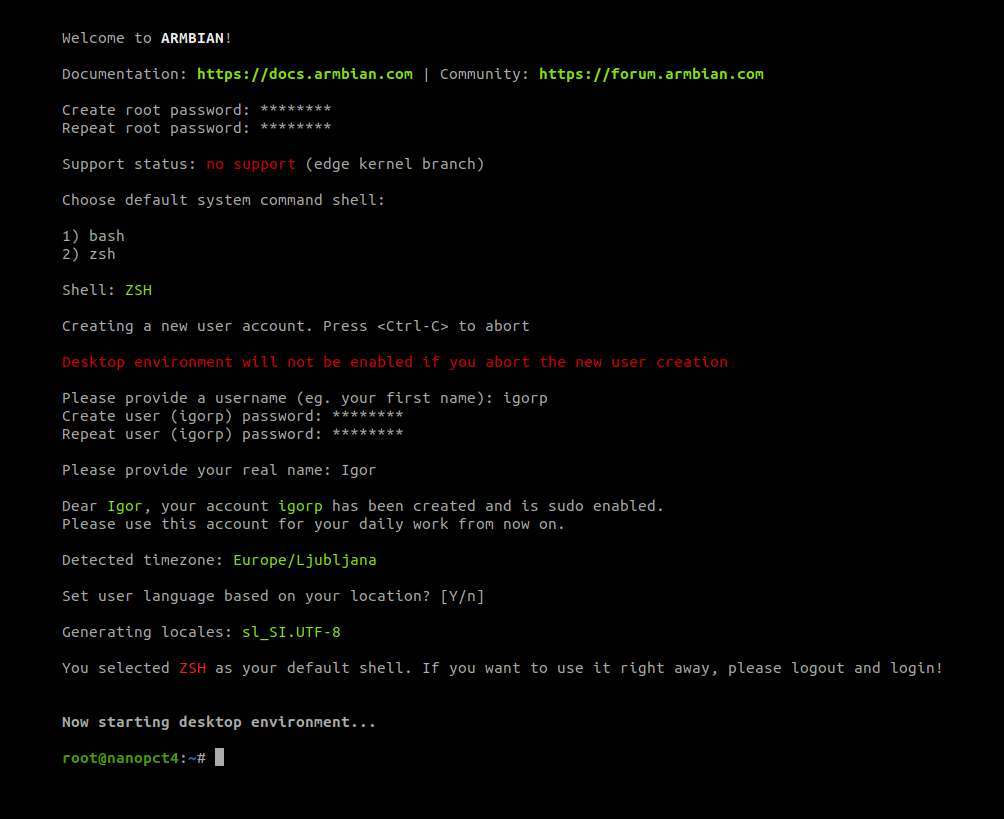
Support is provided in one of two ways:
- Free support is provided via general project search engine, documentation, community forums or IRC/Discord. Keep in mind this is mostly provided by our awesome community members in a best effort manner and therefore there are no guaranteed solutions.
- For commercial or prioritised assistance:
- book a an hour of professional consultation,
- consider becoming a project partner.
- Reach us out at https://armbian.com/contact,
Rolling releases images with Armbian Linux v6.19
Build Date: Mar 13, 2026
| Distro | Variant | User space | Kernel | Torrent | Integrity | Size | |
| Debian 14 (Forky) |
Minimal / IOT | rolling | 6.19.3 | | SHA | ASC | 378.9 MB |
| Ubuntu 24.04 (Noble) |
Gnome | stable | 6.19.3 | | SHA | ASC | 1005.1 MB |
* The torrent option is recommended, as it will likely maximize your download connection speed.
Rolling releases are suitable for Linux enthusiasts who want cutting edge packages and have the skills to fix damage that a bad update might cause. If you want stability in a production environment or low headaches as a novice user, skip rolling releases.
They are only at, build and ship, Debian testing / Arch / Manjaro / Suse Tumbleweed / Kali / Gentoo support quality level!